
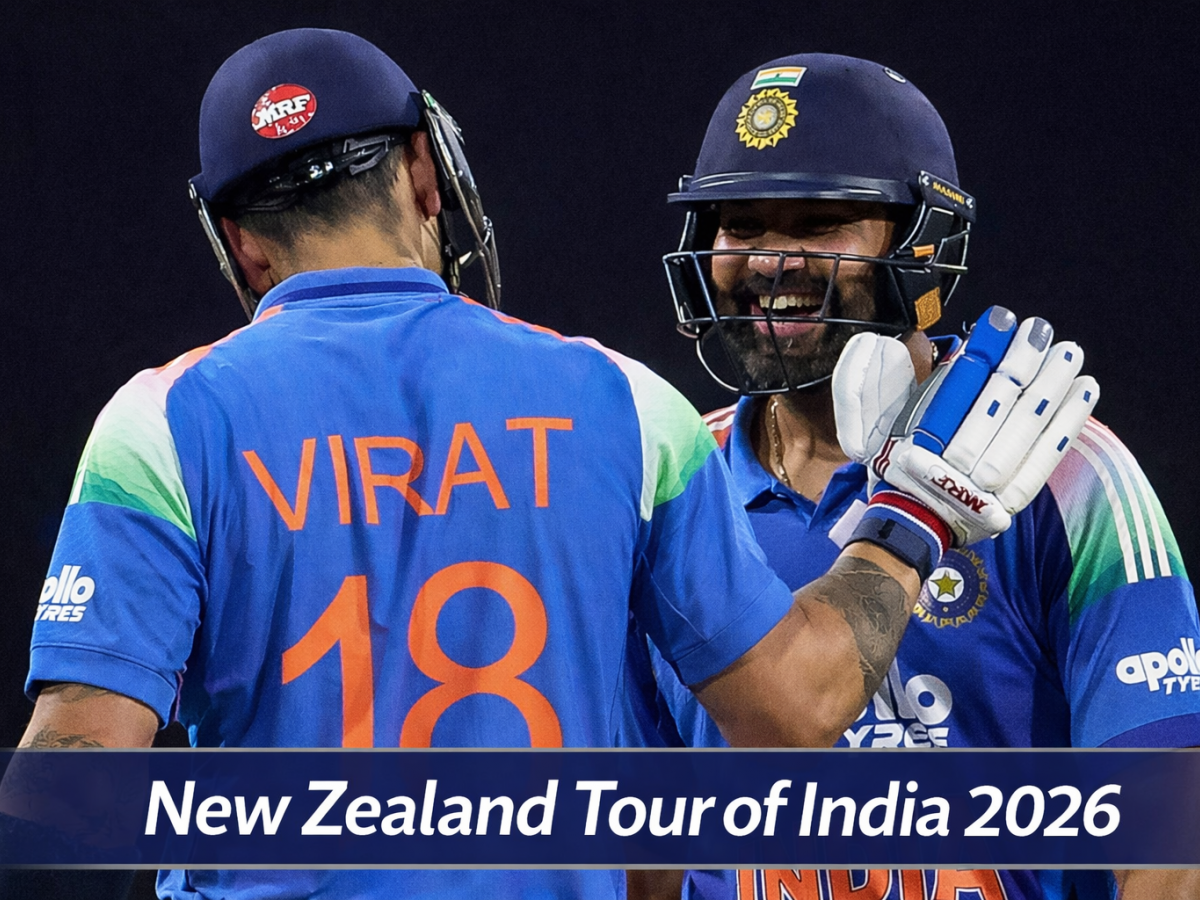
NZTour of India 2025/26
ODIs & T20Is | January 11–31, 2026
India vs New Zealand 2026: Full ODI & T20I Schedule: India and New Zealand are set to begin a multi-format white-ball series later this month, with three ODIs followed by a five-match T20I series, played across eight venues in India. The tour will serve as a significant bilateral assignment for both sides, coming early in the 2026 calendar year and offering extended exposure to varied Indian conditions.
Series Schedule
ODI Series (Day/Night – 1:30 PM IST)
- 1st ODI – Sunday, January 11, 2026
Vadodara - 2nd ODI – Wednesday, January 14, 2026
Rajkot - 3rd ODI – Sunday, January 18, 2026
Indore
T20I Series (Night – 7:00 PM IST)
- 1st T20I – Wednesday, January 21, 2026
Nagpur - 2nd T20I – Friday, January 23, 2026
Raipur - 3rd T20I – Sunday, January 25, 2026
Guwahati - 4th T20I – Wednesday, January 28, 2026
Visakhapatnam - 5th T20I – Saturday, January 31, 2026
Thiruvananthapuram
India: Squad Developments and Selection Context
India’s ODI setup sees the return of Shreyas Iyer and Shubman Gill, both of whom were absent from recent ODI assignments. Their inclusion strengthens the middle and top order respectively, especially with an extended ODI series allowing flexibility in combinations.
Mohammed Siraj is also back in the ODI squad, having last featured in the format during India’s tour of Australia in October 2025. His return adds depth to India’s pace options, particularly in venues like Indore and Rajkot, which have historically offered pace and bounce under lights.
Shreyas Iyer’s availability is expected to be linked to his participation in the Vijay Hazare Trophy, which may determine match readiness heading into the first ODI.
The T20I leg, comprising five matches, provides India with an extended run to assess combinations, bowling rotations, and batting depth across different pitch profiles—from central India to coastal conditions in Visakhapatnam and Thiruvananthapuram.
New Zealand: Leadership and Squad Notes
New Zealand will be led by Michael Bracewell in the ODI series, while Mitchell Santner returns to the side for the T20Is. The split leadership approach reflects New Zealand’s format-specific planning and workload management.
A notable inclusion is left-arm fast bowler Jayden Lennox, who has earned his maiden call-up. Alongside him, uncapped player Clarke has been named in the ODI squad, highlighting New Zealand’s continued emphasis on broadening their player base ahead of future ICC events.
One tactical aspect drawing attention is Glenn Phillips, who has spoken publicly about occasionally batting left-handed as a long-term strategy, particularly to counter spin turning away from him. While not necessarily expected to be deployed regularly in this series, it remains a noteworthy subplot given Indian conditions.
Venues and Conditions
The tour spans a wide geographical spread:
- ODIs in Vadodara, Rajkot, and Indore are expected to feature true surfaces with value for stroke play, especially under lights.
- T20Is move through central, eastern, and coastal India, with Nagpur and Raipur traditionally assisting spinners as games progress, while Guwahati and Visakhapatnam often produce higher-scoring contests.
- Thiruvananthapuram, the final T20I venue, has historically offered balanced conditions, with swing early and grip later in the innings.
Series Significance
With eight matches across two formats, the tour provides both teams a substantial window to test depth, manage workloads, and refine roles. For India, it is an opportunity to reintegrate key players and evaluate bench strength in home conditions. For New Zealand, the series offers exposure to extended white-ball cricket in India, a challenge that continues to be a key benchmark in international cricket.
The series begins on January 11, 2026, with the ODIs setting the platform before attention shifts to a long and potentially demanding T20I contest.
For more match breakdowns and daily reports, follow our latest cricket news on CricDoosra.
Quality posts is the key to interest the viewers to pay a quick visit the web page, that’s what this web page is providing.