
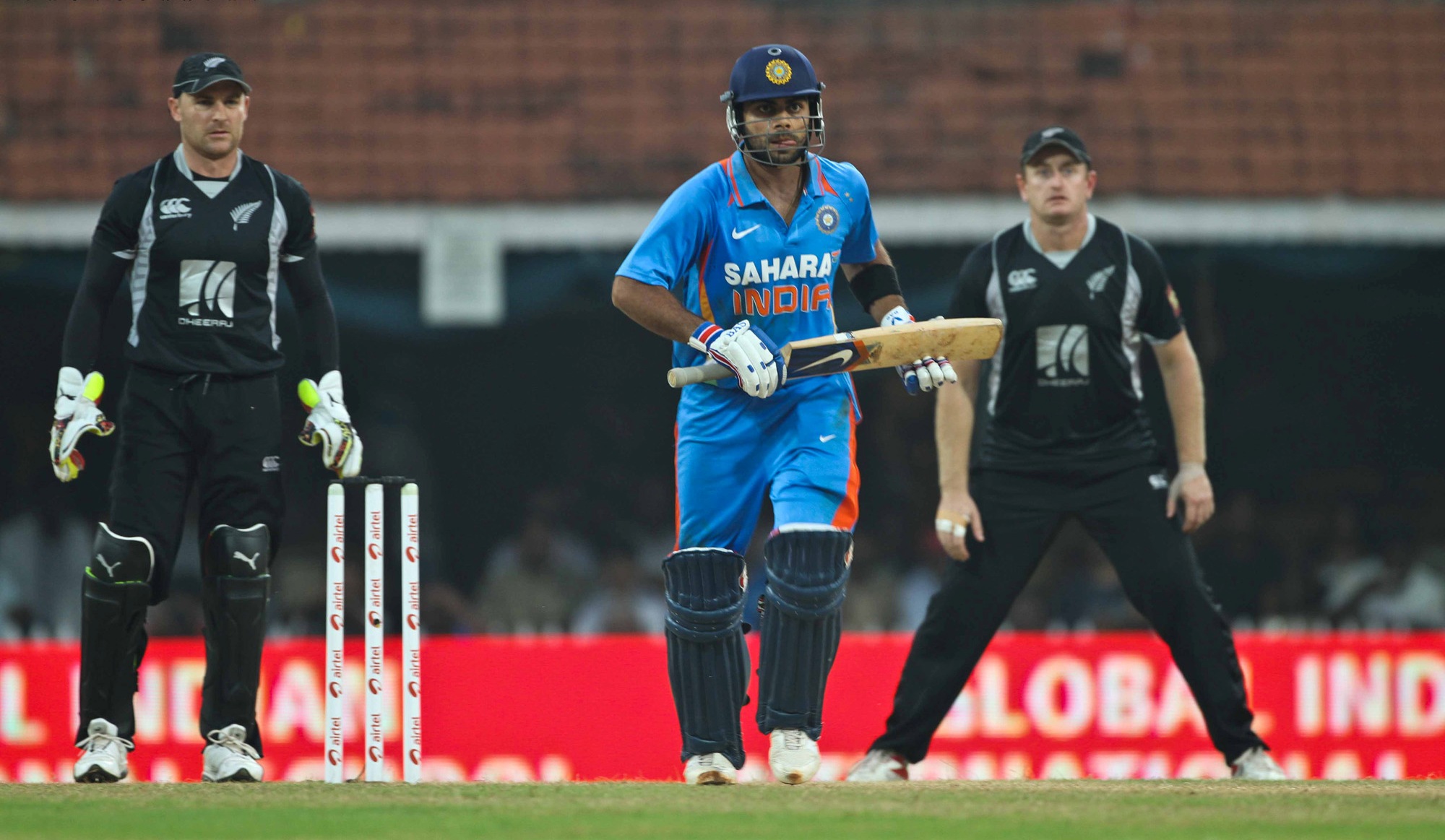
There are innings that announce dominance through excess.
And then there are innings that do something far more unsettling — they disrupt assumptions.
Virat Kohli’s 93 in Vadodara belonged firmly to the latter category.
India won the first ODI against New Zealand by four wickets, chasing 301 with six balls to spare at the Kotambi Stadium. The scorecard will tell you that Kohli fell short of a century, that the chase briefly wobbled, and that KL Rahul finished the job. All of that is accurate.
None of it is the story.
The story is that Kohli is quietly dismantling the version of himself that the cricketing world thought it understood — and replacing it with something more volatile, more permissive, and potentially more dangerous.
The Illusion of Control in ODI Batting
For nearly two decades, Kohli’s ODI greatness has been defined by restraint. His mastery lay in denying risk, not embracing it. He batted as if danger were something to be postponed indefinitely, an inconvenience to be managed rather than confronted.
That approach made him relentlessly successful.
It also made him predictable.
What has changed since the South Africa series is not form, fitness, or technique — all of which were already elite. What has changed is permission, a shift that has already begun to reshape how India approaches this series, explored in India vs New Zealand 2026: When Control Begins to Change Shape.
Kohli now allows himself to disobey the orthodoxy he once embodied.
A New Version Appears Early
From the moment Kohli walked in after Rohit Sharma’s dismissal, it was clear this was not an innings built on calibration. There was no easing in, no ritual of singles to third man. Instead, he stepped into the seamers’ length early, took on the aerial route without hesitation, and forced New Zealand to abandon their preferred lines within his first 20 balls.
This was not reckless aggression. It was pre-emptive intent.
Six boundaries arrived inside those first 20 deliveries — a striking contrast to his 2023 World Cup rhythm, where Kohli preferred to begin at a controlled strike rate before expanding later. Here, he inverted the sequence. He attacked first, organised later.
The effect was immediate. Shubman Gill, under pressure both personal and technical, found space to breathe. New Zealand’s bowlers, already stretched thin by injuries, were pushed into defensive fields far earlier than planned.
Momentum shifted without drama.
That, too, was the point.
Why This Was Not a Loss of Discipline
It would be tempting to frame this as Kohli abandoning caution. That would be inaccurate. What he has done instead is redefine where discipline applies.
Kohli has identified two phases in modern ODI cricket that offer disproportionate value:
The new ball, when strokeplay is most reliable and fields are restricted.
And overs 30 to 40, when the ball is still hard enough to hit through the line, but captains are constrained by fielding regulations.
In Vadodara, he maximised both.
He surged early, then throttled the innings with singles and twos through the middle overs, dictating tempo like a deep-lying playmaker rather than a finisher in waiting. When the window reopened around the 33rd over, he accelerated again — not chasing milestones, but exploiting structure.
That he fell for 93 attempting to hit Kyle Jamieson over mid-off was not evidence of excess. It was evidence of commitment to the method.
The Jamieson Moment — and What It Revealed
Jamieson’s triple strike — Kohli, Jadeja, Iyer in seven balls — injected tension into a chase that had previously felt routine. Suddenly, India needed 59 from 53 with five wickets in hand and two new batters at the crease.
This is where the innings becomes most instructive.
In previous years, Kohli’s dismissal in such circumstances would have felt like a breach of protocol. Here, it felt like a calculated risk that simply did not come off.
Kohli himself acknowledged as much later. Had India been batting first, he would have gone harder. In a chase, experience still intervenes — but not to the extent it once did.
The difference is subtle, but profound.
Kohli is no longer playing only the situation. He is playing his own ceiling.
A Chase That Briefly Forgot Itself
India’s wobble that followed was real. Harshit Rana, walking out amid uncertainty, was not part of any pre-match plan. Washington Sundar’s injury restricted running. The margin narrowed.
Yet even in this moment, the foundations laid earlier mattered. The required rate never spiralled. KL Rahul, unhurried and precise, shepherded the final phase with minimal fuss. India crossed the line not because of a late flourish, but because the chase had been architected to absorb disruption.
That architecture bore Kohli’s imprint.
New Zealand’s 300 was competitive, not commanding. Devon Conway and Henry Nicholls provided a strong platform, but the innings never fully escaped India’s grip. Harshit Rana’s twin strikes stalled momentum, and while Daryl Mitchell ensured respectability with an industrious 84, the total always felt slightly short on a ground where dew later played its role.
More critically, New Zealand lacked the bowling resources to consistently challenge Kohli’s revised approach. Once he seized the initiative early, they were reduced to reacting rather than dictating.
That imbalance proved decisive.
What This Kohli Innings Signals
Kohli’s recent ODI sequence — 74*, 135, 102, 65*, and now 93 — does not merely indicate form.
It indicates experimentation at the highest level.This is not a batter trying to extend his career.
It is a batter interrogating its limits.
By allowing himself to attack earlier, by accepting that “some ball has your name on it,” Kohli has shed the burden of omnipotence. He trusts others to finish, trusts the structure to hold, and trusts that impact can precede longevity.
That trust makes him more dangerous, not less.
There will be days when this approach backfires. There will be innings where early aggression shortens his stay without sufficient compensation. That is the nature of trade-offs.
But for opponents, the warning is unmistakable.
A Kohli who no longer waits for the game to arrive — who chooses instead to confront it on his own terms — alters the geometry of ODI chases entirely.
In the final leg of his career, Kohli is not consolidating legacy.
He is expanding it.
And that, perhaps, is the most unsettling development of all.
The scoreboard will remember 93.
Vadodara will remember a scare.
But what lingered long after was the sense that we are watching a great player give himself permission — finally — to see how high his game can really climb.
For the rest of the world, that should be deeply uncomfortable.
Magnificent goods from you, man. I have consider your stuff prior to
and you are just extremely wonderful. I actually like what you have bought
here, really like what you are saying and the way in which
wherein you say it. You’re making it entertaining and you continue to care for
to keep it wise. I can’t wait to learn much more from you.
This is actually a great web site.